
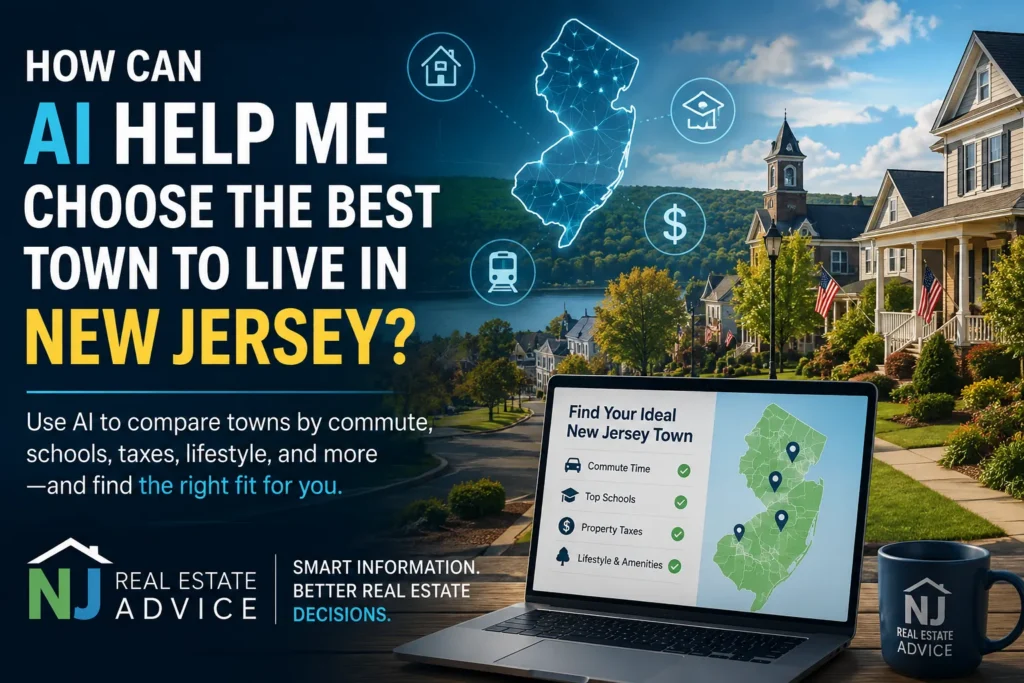
Can Artificial Intelligence Really Identify the Right New Jersey Town for You?
Choosing where to live in New Jersey can be unusually complicated. A town that looks ideal on paper may involve a difficult commute, higher property taxes, limited housing inventory, flood exposure or a housing stock that does not fit your needs. Artificial intelligence can help you organize those variables and narrow a long list of communities into a more practical group of places to investigate.
Yes—AI can help you choose the best town to live in New Jersey, but it should be used as a research and comparison tool rather than as the final decision-maker. Its strongest use is converting your budget, commute, housing preferences and lifestyle priorities into a shortlist that you can verify using current data and firsthand visits.
New Jersey contains densely populated cities, railroad suburbs, rural communities, lake neighborhoods, beach towns, historic downtowns, condominium developments and large-lot exurban areas within a relatively small geographic footprint. Two towns separated by only a few miles can have materially different housing prices, property taxes, transportation options, school systems and development patterns.
An AI platform such as ChatGPT, Gemini, Claude or Perplexity can process a detailed description of what you want and suggest communities that may fit. The quality of the recommendations, however, depends heavily on the quality of the information you provide and whether you verify the output. Town selection is only one part of the process; buyers should also understand the complete sequence for buying a house in New Jersey before beginning an intensive property search.
What Can AI Compare When You Are Choosing an NJ Town?
Home prices and budget
AI can separate towns where your target property is realistically available from towns where your budget would require major compromises in size, condition, location or property type.
Commute requirements
It can identify communities served by particular train lines, bus routes or highways and help distinguish a direct commute from one requiring transfers or additional driving.
Property type
Some markets primarily offer older single-family homes, while others have more townhouses, high-rise condominiums, new construction, age-restricted housing or multifamily properties.
Taxes and ownership costs
AI can help organize municipal tax data, association fees, transportation costs and other recurring expenses—but estimates must be checked against specific properties.
Setting and amenities
Your preferred environment may include a walkable downtown, train station, lake, beach, parks, restaurants, larger lots, quieter streets or proximity to shopping and healthcare.
Property-specific risks
Once you move from town selection to individual homes, AI can help create a checklist for flood zones, septic systems, wells, oil tanks, homeowners associations and local ordinances.
Start by Telling AI What You Actually Need
Asking, “What is the best town in New Jersey?” is unlikely to produce a useful answer. There is no objectively best town for every buyer. A waterfront condominium buyer commuting to Lower Manhattan has a different set of priorities from a remote worker seeking several acres or a retiree looking for a low-maintenance townhouse.
Give the AI enough detail to eliminate communities that clearly do not fit. Useful inputs include:
- Your maximum purchase price and comfortable monthly payment
- Down payment and whether high property taxes affect affordability
- Required bedrooms, bathrooms, square footage and parking
- Single-family, condominium, townhouse or multifamily preference
- Maximum acceptable commute and required destination
- Need for train, bus or highway access
- Preference for walkability, nightlife, quiet streets or larger lots
- Tolerance for renovations, older homes or unusual property systems
- Need for a basement, garage, first-floor bedroom or limited stairs
- Proximity to parks, beaches, lakes, hospitals or family members
- Flood-risk tolerance and insurance concerns
- Any planned move date or inventory constraints
Important: Tell the AI which requirements are mandatory and which are merely preferred. Otherwise, it may recommend towns that satisfy several minor preferences while missing the factor that matters most.
Example prompt for choosing an NJ town
This prompt does not merely request a ranking. It gives the AI a decision framework and requires it to explain the tradeoffs behind each recommendation.
Ask AI to Compare Towns, Not Just Rank Them
A numbered list of “best towns” can create a false sense of precision. A more useful approach is to ask AI to compare a manageable group of towns across the same criteria. That makes assumptions, missing data and compromises easier to see.
| Comparison category | What AI can help organize | What you should verify |
|---|---|---|
| Housing affordability | Likely price ranges and property types within budget | Current listings, recent sales, taxes and monthly costs |
| Commuting | Train lines, bus service, highway access and transfers | Actual door-to-door travel during your commuting hours |
| Housing stock | Typical age, architecture, lot size and development style | Condition and systems of the specific homes available |
| Property taxes | Municipal comparisons and general tax context | The tax bill and assessment for each property |
| Flood exposure | Areas that may require closer flood-risk research | Official mapping, disclosures, insurance and site conditions |
| Lifestyle fit | Downtowns, parks, beaches, trails and shopping access | Whether the town feels right during actual visits |
Prompt for comparing a shortlist
Where AI Can Give You a Misleading Answer
AI can generate a polished explanation even when the underlying information is stale, incomplete or overly generalized. That is particularly important in New Jersey, where individual streets, neighborhoods and properties may differ substantially from a town-wide description.
Common AI mistakes to watch for
- Using old home-price data in a market that has changed
- Confusing a municipality with a postal mailing address or neighborhood name
- Describing a train commute without accounting for station parking or transfers
- Comparing tax rates without comparing actual property tax bills
- Generalizing an entire town from one downtown or neighborhood
- Missing flood, septic, well, oil-tank or homeowners-association issues
- Claiming that a property type is common when current inventory is scarce
- Producing confident school, crime or demographic claims without current sourcing
An AI response should therefore be treated as the beginning of your research. Ask the system to provide dates, explain uncertainty, identify its sources and flag facts that may have changed. Then verify the information through official databases and current market evidence.
Use Authoritative Sources to Verify AI Recommendations
AI becomes more useful when you direct it toward reliable sources rather than allowing it to rely on an unspecified mix of internet content. These resources can help confirm several of the most important town-selection factors:
Other useful sources may include municipal zoning maps, tax-assessor records, county GIS systems, local master plans, utility providers, police traffic information and the actual governing documents for a condominium or homeowners association.
Do Not Use AI to Profile Who Lives in a Town
Buyers sometimes ask AI to identify towns based on the race, religion, national origin, disability, familial status or other protected characteristics of residents. Those are not appropriate criteria for housing recommendations. Housing decisions and real estate guidance must comply with federal and New Jersey fair-housing requirements.
Focus instead on objective features such as price, property type, commuting infrastructure, lot size, taxes, public amenities, housing condition and proximity to destinations that you personally use. Buyers who want information about schools, crime statistics or community data should consult the applicable source directly and draw their own conclusions.
Can AI Tell You Which Neighborhood Within a Town Is Best?
It can help identify named neighborhoods, condominium developments, lake communities or areas near a train station, but neighborhood-level answers require even more caution. Boundaries may be informal, real estate websites may use neighborhood labels inconsistently, and a mailing address may not match the municipality that provides schools or services.
Once you have selected several towns, ask AI to create a neighborhood research checklist rather than asking it to make the final choice. Buyers should then compare the shortlist against current inventory and the likely duration of the search. Our guide to how long it takes to buy a house in New Jersey explains why highly specific location and property requirements can extend the process. You might compare:
- Distance to the station, highway or workplace
- Typical lot and home sizes
- Municipal, mailing and school-district boundaries
- Road noise, airport noise or heavy traffic
- Topography, drainage and flood mapping
- Availability of sidewalks, parks and local businesses
- Public water, sewer, septic and well prevalence
- Association fees and community restrictions
A Better AI Process for Choosing Where to Live in NJ
- Define your non-negotiables. Establish your actual budget, property type, commute limit and mandatory physical features.
- Ask AI for a broad preliminary list. Request explanations and tradeoffs, not merely town names.
- Remove obvious mismatches. Eliminate towns where the housing stock, commute or ownership costs conflict with your needs.
- Compare the remaining towns consistently. Use the same criteria and require the AI to identify uncertainty.
- Verify current data. Check active listings, recent sales, property tax records, transportation schedules and official hazard information.
- Visit the communities yourself. Drive the routes you would actually use and spend time in the areas at different times of day.
- Evaluate individual homes separately. A good town does not automatically make every house a good purchase.
Prompt for testing an AI recommendation
This type of adversarial follow-up is valuable because it forces the AI to search for weaknesses in its own answer instead of simply reinforcing the initial recommendation. The same caution should apply when using AI later in the transaction. Review whether AI should be used to help write a New Jersey purchase offer before relying on generated contract strategy or offer language.
Continue Your New Jersey Home-Buyer Research
AI town-selection research is most useful when it connects to the financial, procedural and negotiation questions that follow. These related NJ Real Estate Advice guides provide the next logical steps:
Narrowed Down Your Towns? Compare the Actual Homes.
AI can help organize your priorities, but current listings reveal whether your plan is realistic. ListOneNJ assists New Jersey buyers with property searches, private showings, offer strategy and transaction guidance. Eligible buyers may also receive a commission rebate at closing when ListOneNJ earns buyer-agent compensation.
The next step is not another generic “best town” list. It is comparing the homes currently available in the communities that meet your requirements.
Learn About the ListOneNJ Buyer RebateAll real estate commissions are negotiable. Buyer rebates are subject to lender approval, transaction terms, applicable law and closing requirements. Rebates may have tax consequences.
Frequently Asked Questions
Can ChatGPT tell me the best town to live in New Jersey?
ChatGPT can recommend towns based on the budget, commute, property type and lifestyle criteria you provide. It cannot determine one objectively best town, and its factual claims should be verified using current listings and authoritative sources.
What information should I give AI before asking where to live?
Include your purchase budget, preferred property type, bedroom and bathroom requirements, commute destination, maximum travel time, tax tolerance, parking needs, desired setting, renovation tolerance and any mandatory features.
Can AI compare New Jersey property taxes by town?
AI can help organize municipal tax information, but tax rates alone do not show what you will pay for a particular house. Verify the current tax bill, assessed value and applicable municipal data for every property you are considering.
Can AI accurately calculate my NJ Transit commute?
AI can identify likely routes and stations, but you should verify current schedules through NJ TRANSIT and account for driving, parking, transfers, walking and service disruptions.
Can AI help me avoid buying in a flood zone?
AI can remind you to investigate flood exposure and may identify known risk areas, but it should not replace an address-specific search of official FEMA mapping, property disclosures, insurance research and professional due diligence.
Should I use school ratings to choose a New Jersey town?
School-rating websites use different methodologies and may oversimplify school performance. Buyers should review New Jersey School Performance Reports and other source data directly based on the educational factors that matter to them.
Do I still need a real estate agent after using AI?
AI may help with preliminary research, but it does not provide property access, inspect homes, obtain seller disclosures, analyze current comparable sales, prepare a transaction strategy or manage a New Jersey purchase through closing. Buyers should also understand how the New Jersey real estate offer process works before moving from town research to active bidding.
This article provides general educational information and is not legal, tax, lending, insurance or engineering advice. AI-generated information may be incomplete or outdated. Verify material facts before making a housing or financial decision.