
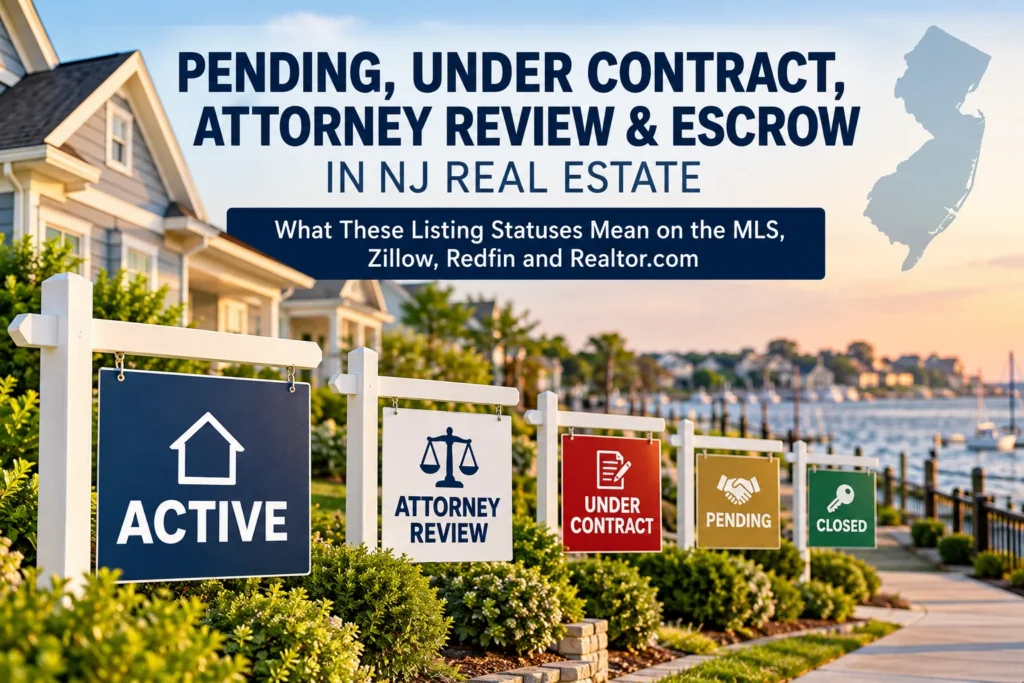
A New Jersey buyer may see “Pending” on Zillow, Redfin or Realtor.com while hearing a real estate agent say a home is “in Attorney Review” or “Under Contract.” Someone familiar with real estate in another state may instead expect to hear that the transaction is “in escrow.”
These phrases are related, but they do not necessarily describe the same thing.
New Jersey residential real estate can be particularly confusing because the contract, the applicable multiple listing service, attorneys, real estate agents and consumer websites may all describe different aspects of the same transaction using different terminology.
Attorney Review describes a stage of the contract process. AR or ARIP are designations used by some multiple listing services during that period. Under Contract is another transaction or listing status whose precise use varies by system. Pending is commonly seen on consumer real estate websites and is also used by some listing systems. “In escrow” is common terminology in other parts of the country, while New Jersey consumers are more likely to hear Attorney Review and Under Contract.
Do not assume that Attorney Review, ARIP, Under Contract, Pending and In Escrow are interchangeable.
This article primarily reflects common residential real estate practices encountered in North Jersey, Central Jersey and the Jersey Shore, including several multiple listing services that serve those markets. Procedures can vary by multiple listing service, brokerage, attorney, contract and region.
South Jersey has historically had some distinct residential real estate practices. The New Jersey Supreme Court has specifically discussed the so-called “South Jersey practice,” including residential transactions in which buyers and sellers may proceed without attorney representation subject to consumer protections. Real estate terminology and transaction procedures also vary substantially from state to state. Read the New Jersey Supreme Court discussion of the South Jersey practice.
- NJ real estate status terms at a glance
- Attorney Review and why New Jersey uses it
- How status rules differ among major listing systems
- Zillow, Redfin, Realtor.com and MLS status
- Pending vs. Under Contract
- Showings and additional offers during Attorney Review
- What “in escrow” means in New Jersey
- Earnest money, escrow deposits and additional deposits
- Buyer’s riders and Attorney Review riders
- Frequently asked questions
NJ Real Estate Status Terms at a Glance
| Term | What it generally describes |
|---|---|
| Active | A property being actively marketed for sale and generally available for buyer activity, subject to the applicable listing rules and seller instructions. |
| Attorney Review | A contractual stage in which attorneys may review, disapprove or propose changes to a broker-prepared residential contract. |
| AR / ARIP | Attorney Review or Attorney Review in Progress. The exact status treatment varies significantly among New Jersey listing systems. |
| Under Contract / UC | A property subject to an accepted contract. The precise point at which this status is used depends on the applicable listing system. |
| Pending | A commonly encountered consumer-facing term and also a defined status in some listing systems. Its exact meaning should not be assumed without knowing the source. |
| In Escrow | Common transaction terminology in some other states. In New Jersey, the word “escrow” is often used more specifically for money or documents being held pursuant to the contract. |
| Earnest Money / Contract Deposit | Buyer funds paid pursuant to the purchase contract. This is a financial term, not a listing status. |
| Additional Deposit | A second or later contractual deposit that may follow a smaller initial deposit. |
| Buyer’s Rider | Additional or revised contract terms commonly proposed by the buyer’s attorney during Attorney Review. |
The important distinction is that listing status, contract status and escrow status are different concepts. A single word displayed on a consumer website may not tell you everything that is happening behind the scenes.
Why New Jersey Real Estate Terminology Can Be Confusing
Most consumers never see the complete professional listing record. They see a home through Zillow, Redfin, Realtor.com, a brokerage IDX website or another consumer search platform.
The buyer’s or seller’s real estate agent may simultaneously be viewing more detailed information inside the applicable multiple listing service. The attorneys are focused on the actual purchase contract, Attorney Review correspondence and negotiated terms.
It is therefore possible for the same property to be described in ways that sound inconsistent:
Consumer website: The home still appears for sale.
Real estate agent: “The property is in Attorney Review.”
Attorney: The parties are exchanging proposed contract modifications.
Those statements can all be true at the same time.
What Does Attorney Review Mean in New Jersey?
Attorney Review is a contractual stage commonly encountered after a buyer and seller sign a Realtor-prepared residential contract.
The attorneys may review the agreement, propose revisions or disapprove it pursuant to the Attorney Review provision. The familiar framework begins with a three-business-day review period, although negotiations can continue beyond three business days when attorneys are exchanging proposed modifications.
This article intentionally does not duplicate the entire process. For timing, attorney-review letters, cancellation rights and what happens when review concludes, see our complete guide: What Is Attorney Review in New Jersey Real Estate Transactions?
Why Is Attorney Review So Prominent in New Jersey?
Attorney Review is not simply a phrase New Jersey agents adopted as a local custom. Its prominence has a specific legal history.
New Jersey courts addressed whether licensed real estate brokers and salespersons could prepare residential sale contracts without engaging in the unauthorized practice of law. The resulting framework permits real estate licensees to prepare qualifying residential contracts while protecting the parties’ opportunity to have attorneys review those broker-prepared agreements.
The New Jersey Supreme Court has described the purpose of the Attorney Review clause as protecting buyers and sellers from becoming bound by a broker-prepared contract without an opportunity to obtain legal review. The Court has continued to address how the Attorney Review process operates as real estate practice and communications have evolved. See Conley v. Guerrero, New Jersey Supreme Court.
This helps explain why someone relocating to New Jersey may encounter terminology that sounds unfamiliar:
Attorney Review also does not mean every New Jersey buyer or seller is legally required to retain an attorney. We discuss that separately in Do I Have to Use a New Jersey Real Estate Attorney?
Attorney Review Status Is Not Uniform Across New Jersey
There is no single statewide multiple listing service controlling every residential listing in New Jersey.
That matters because several major listing systems serving North Jersey, Central Jersey, Hudson County, the Jersey Shore and portions of South Jersey handle Attorney Review differently.
| Listing system | Treatment during Attorney Review |
|---|---|
| New Jersey MLS (NJMLS) | ARIP is required after the contract is signed by buyer and seller. ARIP remains an Active status and showings normally continue unless the seller completes the required no-further-showings procedure. |
| Garden State MLS (GSMLS) | A signed contract pending Attorney Review remains Active and available for showing. Identifying the listing as ARIP is optional. |
| All Jersey MLS (AJMLS) | AR is explicitly listed as an optional status and is an Active status. Upon conclusion of Attorney Review, the status must change to U or US as applicable. |
| RMLS / Hudson County MLS | ARIP specifically means Attorney Review is in progress and the owner has instructed the listing broker not to continue showing the property. |
| MOREMLS | Attorney Review is an Active subtype when the seller continues showing. After Attorney Review concludes, the listing must move to Under Contract Continue to Show or Pending as appropriate. |
| Bright MLS | Attorney Review Period can be a subcategory of Active Under Contract when an offer has been accepted but the seller continues showing and accepting backup offers. |
This table illustrates why statements such as “Attorney Review always means Pending” or “Under Contract always means exactly the same thing everywhere in New Jersey” are unreliable.
New Jersey MLS (NJMLS)
NJMLS requires the listing status to be changed to ARIP — Attorney Review in Progress — within 24 hours after an offer has been signed by both buyer and seller.
NJMLS expressly states that ARIP is still Active. The property should continue to be shown unless the sellers execute the required No Further Showings form. Once Attorney Review concludes, the listing must be changed to Under Contract within 24 hours.
Source: New Jersey MLS Policies.
Garden State MLS (GSMLS)
GSMLS takes a different approach. Its rules state that a listing subject to an executed contract that is still pending Attorney Review remains Active and available for showing in accordance with the listing agreement.
The listing broker has the option to identify the property as ARIP but is not required to do so. GSMLS then defines a listing as Under Contract — also referenced in its rules as pending — when the executed contract remains in effect and has survived Attorney Review when review was applicable.
Source: Garden State MLS Rules and Regulations.
All Jersey MLS (AJMLS)
AJMLS also makes Attorney Review status optional.
Its Quick Reference Guide to Procedures places AR under the heading “Optional Statuses” and states that AR is an Active status. The guide further states that upon conclusion of Attorney Review, the status must become U or US as applicable.
This is another clear example of a signed contract being in Attorney Review while the professional listing status remains Active.
Source: All Jersey MLS Quick Reference Guide to Procedures, revised July 11, 2024.
RMLS / Hudson County MLS
The Realty Multiple Listing System, Inc., also identified in its rules as the Hudson County Multiple Listing Service, uses a particularly important variation.
Its rules define Active as a listing available to be shown where the owner or agent is accepting offers.
Its definition of ARIP is narrower: Attorney Review is in progress and the owner instructs the listing broker not to continue showing the listing.
The rules further require status changes to be reported within 24 hours. When an offer has been accepted and the property is no longer available for showings, the listing broker must change the property from Active to ARIP or Under Contract as appropriate.
This is materially different from NJMLS, where ARIP itself remains Active and generally continues to be shown.
Source: Realty Multiple Listing System / Hudson County MLS Rules and Regulations, Section 4.
Monmouth Ocean Regional MLS (MOREMLS)
MOREMLS uses an Attorney Review subtype of Active. Its April 2026 rules state that this subtype is required when the seller continues showing the property during Attorney Review.
Within one business day after Attorney Review concludes, the property must move to either Under Contract Continue to Show or Pending, depending on whether it remains available for showings.
MOREMLS defines Pending as an accepted offer where the listing is no longer on the market or available to be shown.
Source: MOREMLS Rules and Regulations, updated April 2026.
Bright MLS
Bright MLS demonstrates why even the phrase Under Contract should not be assumed to mean precisely the same thing in every system.
Bright defines Active Under Contract as a property where a written offer has been accepted but the seller continues showing the home and accepting backup offers. Its listed subcategories specifically include Attorney Review Period.
Bright separately defines Pending for a later situation in which an agreement of sale is in effect and the seller is no longer marketing the property for additional showings.
Source: Bright MLS Rules, Appendix B Status Definitions.
Why Can Zillow, Redfin or Realtor.com Show Something Different?
Zillow, Redfin and Realtor.com are consumer-facing real estate websites. They receive listing information through feeds and present it using consumer-oriented interfaces and status labels.
The professional listing system may contain more granular information than the consumer website displays.
For example, MOREMLS has publicly explained that its Attorney Review and Under Contract Continue to Show options are internal Flexmls subtypes that are visible to agents, while listings using those options are transmitted to the Internet as Active listings.
Source: Monmouth Ocean Regional REALTORS® Flexmls status guidance.
That means a buyer can encounter this apparently contradictory situation:
Zillow, Redfin or another website: The property appears available.
Listing agent: “The seller already signed a contract and the property is in Attorney Review.”
Those statements are not necessarily inconsistent.
Likewise, this article does not attempt to reverse-engineer every Zillow, Redfin or Realtor.com status into a specific underlying professional status. Different data sources and feeds can behave differently.
The safest consumer question is therefore not:
“What does the word on Zillow prove?”
It is:
“What is the actual transaction status, are showings continuing, and is the seller considering additional offers?”
Is Attorney Review the Same as Pending?
No universal New Jersey rule makes Attorney Review and Pending synonymous.
The major listing systems above demonstrate that clearly:
- NJMLS treats ARIP as Active and later changes the property to Under Contract.
- GSMLS allows an Attorney Review listing to remain Active and makes ARIP optional.
- AJMLS describes AR as an optional Active status.
- RMLS uses ARIP specifically when Attorney Review is occurring and the seller has instructed the broker to stop showing.
- MOREMLS places Attorney Review under Active when showings continue.
- Bright MLS can place Attorney Review beneath Active Under Contract.
“Pending” is therefore better understood as a term whose exact meaning depends on the system displaying it rather than as a universal synonym for Attorney Review.
Is Under Contract the Same as Attorney Review?
Again, not universally.
Within NJMLS and GSMLS, the distinction is relatively straightforward: Attorney Review precedes Under Contract.
But Bright MLS uses the phrase Active Under Contract and specifically allows Attorney Review Period as a subcategory.
RMLS also defines Under Contract to include either a contract prepared by an attorney or a contract that is out of Attorney Review.
So if someone tells you that a property is “under contract,” a useful follow-up question may be:
“Has Attorney Review concluded?”
Can a House Still Be Shown During Attorney Review?
Yes. In many New Jersey transactions, a property can continue to be shown while a signed contract is undergoing Attorney Review.
But the exact treatment depends on the seller’s instructions and the applicable listing-system rules.
NJMLS generally continues showings during ARIP unless the seller executes its no-further-showings procedure. GSMLS considers a contract pending Attorney Review Active and available for showing under the listing agreement. MOREMLS specifically uses its Active Attorney Review subtype when the seller continues showings.
RMLS illustrates the opposite presentation: its ARIP definition specifically includes the seller instructing the broker not to continue showing.
This is why consumers should not try to infer showing availability merely from hearing the words “Attorney Review.”
Can Another Buyer Submit an Offer During Attorney Review?
Additional buyer interest can arise while a property is in Attorney Review.
Whether the seller can terminate an existing agreement and proceed with another buyer depends on the actual contract and Attorney Review status. We address that specific issue separately in Can a Seller Replace My Contract During Attorney Review?
There is also a practical distinction between another offer arriving later and a conventional bidding war.
In day-to-day residential practice, competitive bidding most often develops while multiple buyers are simultaneously interested in a newly marketed property. The seller may then compare competing offers or call for Highest and Best before selecting one contract.
Another offer can certainly arise afterward, but sellers should not assume that signing the first acceptable contract and entering Attorney Review will reliably create a second round of competition.
For more on how sellers and buyers handle simultaneous competing offers, see What Does Highest and Best Mean in New Jersey Real Estate?
What Does “In Escrow” Mean in New Jersey Real Estate?
The phrase “in escrow” is common in national real estate media and in some other states, where consumers may use it broadly to describe the period between contract acceptance and closing.
In the North Jersey, Central Jersey and Jersey Shore transactions discussed in this guide, consumers are generally more likely to hear transaction milestones described as:
The word escrow is nevertheless important in New Jersey. It often describes the handling of money or documents rather than functioning as the primary name for the entire contractual stage.
For example:
- a buyer’s contract deposit may be held in an escrow account;
- a real estate brokerage or attorney may act as the contractual escrow holder;
- funds may remain in escrow pending resolution of a closing issue; or
- a mortgage lender may maintain a separate escrow account for future taxes and insurance.
Those uses of “escrow” should not automatically be confused with a listing status.
Earnest Money, Initial Deposit, Additional Deposit and Escrow Deposit
Consumers may also hear several different terms used for money associated with the purchase contract:
- earnest money;
- earnest money deposit;
- contract deposit;
- initial deposit;
- additional deposit; and
- escrow deposit.
These terms concern the buyer’s funds. They do not determine whether Zillow should say Pending, whether an MLS record should show Attorney Review or whether Attorney Review has begun.
Many New Jersey residential contracts provide for a smaller initial deposit followed by a larger additional deposit. The amount, timing and escrow holder are controlled by the contract and any Attorney Review modifications rather than by one universal statewide rule.
Because this topic deserves its own treatment, see When Is the Buyer’s Deposit Due in a New Jersey Real Estate Transaction? for initial deposits, additional deposits, earnest money, escrow holders and common timing questions.
What Is a Buyer’s Rider During Attorney Review?
Another phrase consumers may hear during this stage is buyer’s rider, seller’s rider or Attorney Review rider.
In ordinary practice, the attorneys do not necessarily throw away the entire Realtor-prepared contract and start from scratch. An attorney may send proposed modifications, additional protections or revised terms that become part of the agreement if accepted.
A buyer’s rider may address subjects such as inspections, financing, appraisal, closing dates, title issues, property condition, representations, included items or other transaction-specific concerns.
The exact terminology varies among attorneys. “Buyer’s rider” should therefore be understood as practical transaction vocabulary rather than the name of one universal New Jersey form.
For a broader explanation of what attorneys review and how Attorney Review modifications work, return to our complete Attorney Review guide.
What Buyers Should Actually Ask
If a property looks Active on Zillow, Redfin, Realtor.com or another website but your agent tells you it is in Attorney Review, do not assume either source must be wrong.
Instead, ask:
- Is the existing contract still in Attorney Review?
- Has Attorney Review already concluded?
- Is the seller continuing to allow showings?
- Is the seller considering additional offers?
- What status does the professional listing record currently show?
Those questions provide considerably more useful information than relying on a single consumer-facing label.
What Sellers Should Understand About Status Changes
Sellers should also avoid assuming that a status change automatically destroys—or preserves—buyer exposure.
Whether a listing continues to be shown, how Attorney Review is identified and what information is distributed publicly depend partly on the applicable system and the seller’s instructions.
For sellers trying to generate multiple offers, the most important competitive period is often the initial exposure of the listing. Pricing, presentation, showing access, market conditions and the concentration of interested buyers generally matter more than hoping a bidding war will develop after the seller has already selected an initial contract.
For a broader look at the sale process, see What Are the Steps in Selling a House in New Jersey?
Bottom Line
Pending, Under Contract, Attorney Review, ARIP and In Escrow should not be treated as interchangeable New Jersey real estate terms.
Attorney Review describes an important contractual stage. Different multiple listing services serving New Jersey handle that stage differently. Consumer websites such as Zillow, Redfin and Realtor.com may display less granular terminology than an agent sees in the professional listing record.
Meanwhile, escrow, earnest money and additional deposits describe financial or contractual mechanics rather than necessarily identifying the listing’s public status.
The result is that a property can have a signed contract, be undergoing Attorney Review and still appear available to consumers online without anything necessarily being wrong.
When the status matters, buyers and sellers should determine the actual contract stage, applicable listing status and showing instructions instead of relying on one word displayed by one website.
Frequently Asked Questions
Is Attorney Review the same as Pending in New Jersey?
No. Attorney Review describes a contractual review stage. Pending is a listing-status term whose precise meaning depends on the listing system or consumer website. Several major systems serving New Jersey treat Attorney Review differently from Pending.
What does ARIP mean in NJ real estate?
ARIP means Attorney Review in Progress. Its exact use varies by listing system. NJMLS treats ARIP as an Active status, GSMLS makes the ARIP designation optional, and RMLS uses ARIP when Attorney Review is underway and the seller has instructed the broker not to continue showings.
Can a house still be Active during Attorney Review in New Jersey?
Yes. Several major listing systems serving New Jersey expressly allow a property with a signed contract pending Attorney Review to remain Active. The exact status and showing requirements depend on the applicable system and seller instructions.
Why does Zillow or Redfin still show a house for sale during Attorney Review?
Consumer websites do not necessarily display every internal status or subtype available to real estate professionals. A property can therefore have a signed contract undergoing Attorney Review while still appearing available on a consumer real estate website.
Does Under Contract mean Attorney Review is finished in NJ?
It depends on the applicable listing system. NJMLS and GSMLS generally distinguish Attorney Review from the later Under Contract stage, while Bright MLS can use Active Under Contract with Attorney Review Period as a subcategory.
What does “in escrow” mean in New Jersey real estate?
In New Jersey, escrow commonly refers to money or documents being held pursuant to a transaction, such as a buyer’s contract deposit. Other states may use “in escrow” more broadly as a transaction milestone between contract and closing.
Is earnest money the same as an additional deposit in New Jersey?
Earnest money is a broad term for buyer funds deposited toward the purchase. A New Jersey contract may divide that deposit into a smaller initial deposit and a larger additional deposit. The actual amounts and deadlines are controlled by the contract and any Attorney Review modifications.
Can another buyer make an offer while a NJ house is in Attorney Review?
Another buyer can submit an offer while Attorney Review is pending. The seller’s ability to terminate an existing agreement and proceed with another buyer depends on the contract and legal circumstances, so the parties should obtain advice from their attorneys.
Do Attorney Review and listing-status rules work the same throughout New Jersey?
No. Multiple listing services serving different New Jersey markets use different status definitions and procedures. Regional transaction customs can also differ, including some historically distinct practices in South Jersey.
Looking to Reduce Real Estate Commission Costs in New Jersey?
NJRealEstateAdvice.com is an independent educational resource. For brokerage services, ListOneNJ offers full-service 1% listings for New Jersey sellers and buyer commission rebates for qualifying buyers.
Program terms, lender requirements and closing conditions apply.
Visit ListOneNJDisclaimer: This article provides general educational information about New Jersey residential real estate terminology and common transaction practices. It is not legal advice. Procedures may vary by region, multiple listing service, brokerage, attorney, contract, property type and individual transaction. South Jersey practice may differ from customs commonly encountered in North Jersey, Central Jersey and the Jersey Shore. Listing-system rules and consumer website data feeds can also change over time. Buyers and sellers should consult their own New Jersey real estate attorney regarding contractual rights and their real estate professional regarding the current listing and showing status of a particular property.