
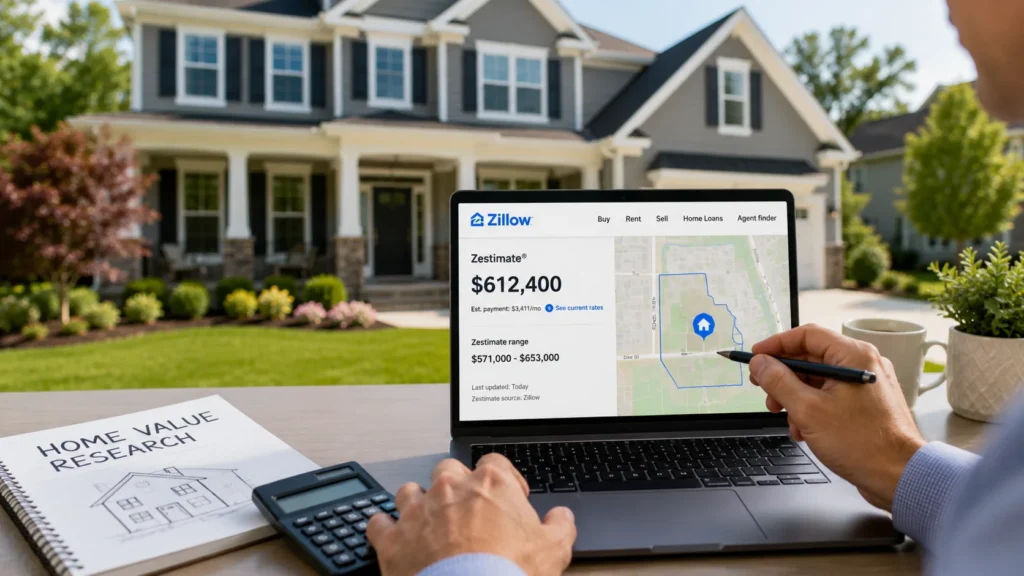
Many New Jersey homeowners check Zillow before contacting a real estate agent, ordering an appraisal or deciding whether to sell. Because the Zestimate displays a specific dollar amount, it can appear to be a definitive statement of market value.
In reality, a Zestimate is an automated estimate based on the property information and market data available to Zillow. It may be reasonably close for some homes and materially inaccurate for others.
What Is a Zillow Zestimate?
A Zestimate is Zillow’s automated estimate of a home’s market value. Zillow calculates the estimate through a proprietary valuation model that analyzes information such as:
- Public tax and property records
- Multiple listing service data
- Prior sale history
- Recent nearby sales
- Square footage
- Bedroom and bathroom counts
- Lot size and location
- Current market trends
- Listing information when a home is offered for sale
- Property facts submitted or corrected by users
Zillow describes the Zestimate as a free starting point for understanding what a property may be worth. Zillow also expressly states that the Zestimate is not an appraisal and cannot be used in place of one.
How Accurate Is the Zillow Zestimate?
Zillow publishes national and regional accuracy statistics for both on-market and off-market homes. The reported error rates change as Zillow updates its valuation model and receives additional sale data.
Rather than interpreting one national percentage as a promise of accuracy for an individual New Jersey home, homeowners should understand what the statistic actually means.
A median error rate means that half of the qualifying Zestimates were closer to the final sale price and half had a larger percentage error. The Zestimate can be too high or too low.
You can review Zillow’s current published methodology and accuracy information on its official Zestimate explanation page.
Why Are On-Market Zestimates Often More Accurate?
A Zestimate may change after a home is listed because Zillow then receives additional information that was unavailable while the property was off the market.
New listing information may include:
- The asking price
- Updated photographs
- A current property description
- Verified room counts
- Renovation details
- Listing activity
- Days on market
- Current comparable listings
This additional information can improve the estimate. It also means that an on-market Zestimate is not necessarily an entirely independent confirmation of the listing price.
For example, if a home is listed for $700,000 and the Zestimate moves closer to $700,000 shortly afterward, that does not prove that the property is worth exactly $700,000. The list price and other listing data may have become new inputs in the model.
Why Can New Jersey Zestimates Be Inaccurate?
New Jersey contains dense development, irregular municipal boundaries, highly localized school districts, varied property types and substantial differences between neighborhoods located only a short distance apart. These factors can make automated valuation more difficult.
Municipal Boundaries
Nearby homes may be located in different municipalities with different schools, tax structures, services and buyer demand.
Property Condition
Public data may not reveal whether a home is fully renovated, severely dated or affected by deferred maintenance.
Incomplete Records
Square footage, room counts, additions and finished areas may be missing, outdated or inconsistently reported.
Unique Features
Waterfront access, acreage, detached studios, unusual layouts and premium lots may be difficult to model.
Condominium Differences
End units, basements, garages, floor levels and locations within the same development can create meaningful value differences.
Location Stigma
Traffic, flooding, drainage, power lines, commercial uses and highway noise may affect buyer response more than public data suggests.
Nearby Homes Are Not Always Comparable
An automated model may rely on geographically nearby properties even when buyers would not consider them true substitutes.
Two homes located within a short distance may differ because they are in separate:
- Municipalities
- School districts
- Neighborhoods
- Lake communities
- Condominium associations
- Flood zones
- Tax districts
A home directly across a town boundary may have different schools, taxes, utilities or neighborhood appeal. These differences can materially affect what buyers are willing to pay, even when the homes appear similar in public records.
Public Records May Not Show the Home’s True Condition
Automated valuation models are heavily dependent on structured data. That data may identify a home as having four bedrooms, two bathrooms and 2,000 square feet, but it may not reveal whether the home has:
- A newly renovated kitchen
- Original 1970s bathrooms
- Water intrusion
- A failing roof
- An obsolete heating system
- A high-quality finished basement
- An awkward or functionally obsolete floor plan
- Substantial structural or environmental issues
Condition can have a major effect on New Jersey buyer behavior. Two homes with similar public-record characteristics may sell for substantially different prices when one is move-in ready and the other requires extensive work.
Why Unique New Jersey Homes Are Harder to Estimate
Automated models generally perform best when a property closely resembles a large number of recent nearby sales. Accuracy can decline when the home has unusual features or when few comparable properties have sold.
Examples include:
- Lakefront or lake-access homes
- Properties with substantial acreage
- Homes with detached studios or workshops
- Converted garages
- Finished attics with unconventional access
- Homes without basements in basement-dominant neighborhoods
- Properties with private septic systems
- Historic homes
- Highly customized luxury properties
- Homes containing unpermitted or undocumented improvements
The more unusual the property, the more important human review becomes.
Can a Zestimate Be Too High?
Yes. A Zestimate may overstate market value when Zillow:
- Relies on superior nearby sales
- Uses inaccurate square footage
- Does not recognize dated condition
- Fails to account for an inferior location
- Overvalues finished or converted space
- Misses flood, drainage or environmental concerns
- Groups the home with a stronger nearby micro-market
An inflated Zestimate can create unrealistic seller expectations. A homeowner may assume that the automated estimate represents a minimum acceptable sale price even when recent comparable sales and active buyer feedback support a lower value.
Buyers do not determine their offers based solely on the seller’s Zestimate. They compare the home with competing properties available within the same price range.
Can a Zestimate Be Too Low?
Yes. Zillow may undervalue a property when it lacks reliable information about:
- Major renovations
- Expanded living space
- A premium lot
- Superior views
- Exceptional interior condition
- A desirable location within a development
- Recent mechanical improvements
- Features not reflected in public records
A low Zestimate does not impose a ceiling on the eventual sale price. When a home is properly marketed and attracts competing buyers, it can sell above the Zestimate.
Can a Homeowner Change the Zestimate?
A homeowner cannot manually choose a new Zestimate. However, Zillow allows owners to claim a property and review the facts displayed on the property page.
Homeowners should verify:
- Square footage
- Bedroom count
- Bathroom count
- Lot size
- Property type
- Prior sale information
- Major property features
Zillow states that updated home facts are incorporated into the Zestimate, although correcting information does not guarantee that the estimate will increase or change immediately.
Homeowners should avoid overstating living area or representing unpermitted improvements as legally recognized space merely to influence an online estimate.
Is a Zestimate the Same as an Appraisal?
No. A Zestimate is a computer-generated estimate based on available data. An appraisal is a professional opinion of value prepared by a licensed or certified appraiser for a particular purpose.
Zillow Zestimate
- Generated automatically
- Relies on available property and market data
- May update several times per week
- Does not ordinarily include an interior inspection
- Cannot replace an appraisal
Professional Appraisal
- Prepared by a licensed or certified appraiser
- Usually includes property-specific analysis
- Uses selected and adjusted comparable sales
- Considers condition and quality
- May be used for mortgage or other formal purposes
An appraisal is still an opinion of value rather than a guaranteed sale price. However, it involves property-specific professional analysis that an automated estimate does not replicate.
Is a Zestimate the Same as a Comparative Market Analysis?
No. A comparative market analysis, commonly called a CMA, is typically prepared by a real estate agent or broker to estimate how the property is likely to perform in the current market.
A useful CMA considers:
- Recent closed sales
- Pending sales
- Active competing listings
- Expired and withdrawn listings
- Property condition
- Location differences
- Current inventory
- Buyer preferences
- Pricing strategy
- Likely market response
A CMA is not an appraisal. Its principal advantage over an automated estimate is that a knowledgeable agent can distinguish between a physically nearby property and a genuinely relevant comparable sale.
Zestimate Versus CMA Versus Appraisal
| Valuation Method | Primary Use | Main Strength | Main Limitation |
|---|---|---|---|
| Zestimate | Preliminary online estimate | Fast, free and widely available | Dependent on automated data and modeling |
| Comparative Market Analysis | Listing and market-positioning guidance | Can account for current competition and local distinctions | Not a formal appraisal or guaranteed sale price |
| Professional Appraisal | Lending, refinancing and other formal valuation needs | Property-specific professional analysis | Still an opinion of value and may differ from market response |
Should a New Jersey Seller Use the Zestimate as the Listing Price?
Not automatically. A Zestimate can be considered as one data point, but a listing price should also reflect:
- Recent relevant sales
- Current competing listings
- Pending sales and market momentum
- The home’s actual condition
- Location advantages and disadvantages
- Likely appraisal risk
- Current buyer demand
- The seller’s desired timing
- Buyer search-price brackets
A Zestimate of $612,400 does not necessarily make $612,400 the best listing price. Depending on the market, a strategic price such as $599,900, $619,900 or $625,000 may attract a different group of buyers and produce a different result.
Pricing strategy should be based on how buyers search and compare homes, not on preserving the appearance of mathematical precision.
Should a Buyer Base an Offer on the Zestimate?
No. A buyer should not assume that a low Zestimate proves the property is overpriced or that a high Zestimate proves the home is a bargain.
Buyers should analyze:
- Recent comparable sales
- Current competing homes
- Property condition
- Inspection concerns
- Likely appraisal risk
- Competing-offer activity
- The buyer’s own budget and priorities
The final sale price results from negotiation and actual market demand. Zillow does not set the contract price.
Why Did the Zestimate Change After the Home Was Listed?
Zillow explains that an on-market home provides additional valuation signals, including the listing price, listing details and recent market activity.
This can cause the Zestimate to move shortly after the property becomes active. The change does not necessarily mean Zillow independently discovered that the home’s value suddenly increased or decreased. The valuation model received new information.
For this reason, sellers should be cautious about treating a post-listing Zestimate as confirmation that the asking price is correct.
What Happens When the Zestimate and Buyer Feedback Disagree?
Actual buyer behavior should receive substantial weight. If a property receives many showings but no offers, repeated objections to condition or consistent feedback that the price is too high, the market may be rejecting the asking price despite a higher Zestimate.
Conversely, if several qualified buyers compete and submit offers above the Zestimate, the market may be demonstrating that the automated estimate was too low.
How Should New Jersey Homeowners Use the Zestimate?
The Zestimate is most useful as:
- An early planning reference
- A broad indicator of value trends
- A reason to review public property facts
- A starting point for researching recent sales
- One input among several valuation sources
It is less suitable as:
- A guaranteed sale price
- A replacement for an appraisal
- A replacement for a CMA
- Proof that an asking price is correct
- Proof that a buyer’s offer is unreasonable
- The sole basis for a major financial decision
The Bottom Line
The Zillow Zestimate can be reasonably accurate for some New Jersey properties, particularly when the home closely resembles numerous recent nearby sales and Zillow has complete, current information.
It may be considerably less reliable when the property is unique, condition differs substantially from nearby homes, municipal boundaries matter, public records are incomplete or location disadvantages are difficult for an algorithm to measure.
Use the Zestimate as a starting point—not a final answer. A realistic New Jersey home valuation should combine comparable sales, current competition, property condition, local buyer behavior and professional judgment.
For additional seller guidance, read about how quickly you can list a home in New Jersey, learn how to compare Realtor fees in New Jersey, or request a market analysis through ListOneNJ’s New Jersey home valuation service.
Frequently Asked Questions
How accurate is the Zillow Zestimate in New Jersey?
Accuracy varies by property. A Zestimate may be relatively close when Zillow has complete information and numerous comparable sales, but it can be materially inaccurate for unique homes, properties with incorrect records or homes in highly localized markets.
Why did my Zestimate change after I listed my home?
Once a home is listed, Zillow may receive new information such as the asking price, listing description, photographs, property facts and recent market activity. Those additional valuation signals can cause the Zestimate to change.
Can my New Jersey home sell above the Zestimate?
Yes. The Zestimate does not cap a property’s sale price. Superior condition, renovations, a premium location or competing offers may cause a home to sell above the estimate.
Can a Zestimate be higher than the home’s market value?
Yes. A Zestimate may be too high when Zillow relies on superior comparable properties, uses incorrect home facts or does not fully account for dated condition, flooding, traffic or other location disadvantages.
Should I use the Zestimate as my listing price?
Not by itself. A listing price should reflect recent comparable sales, current competition, property condition, buyer demand, location and a deliberate pricing strategy.
Need a More Property-Specific New Jersey Home Value?
Compare your Zestimate with relevant sales, current competition and the actual condition of your home before choosing a listing price.
Request a New Jersey Home ValuationSource and disclosure: Review Zillow’s official Zestimate explanation and current accuracy information. Zillow, Zestimate and related names are trademarks of their respective owner. This article provides general real estate information and is not an appraisal, legal opinion, tax advice or financial advice.