
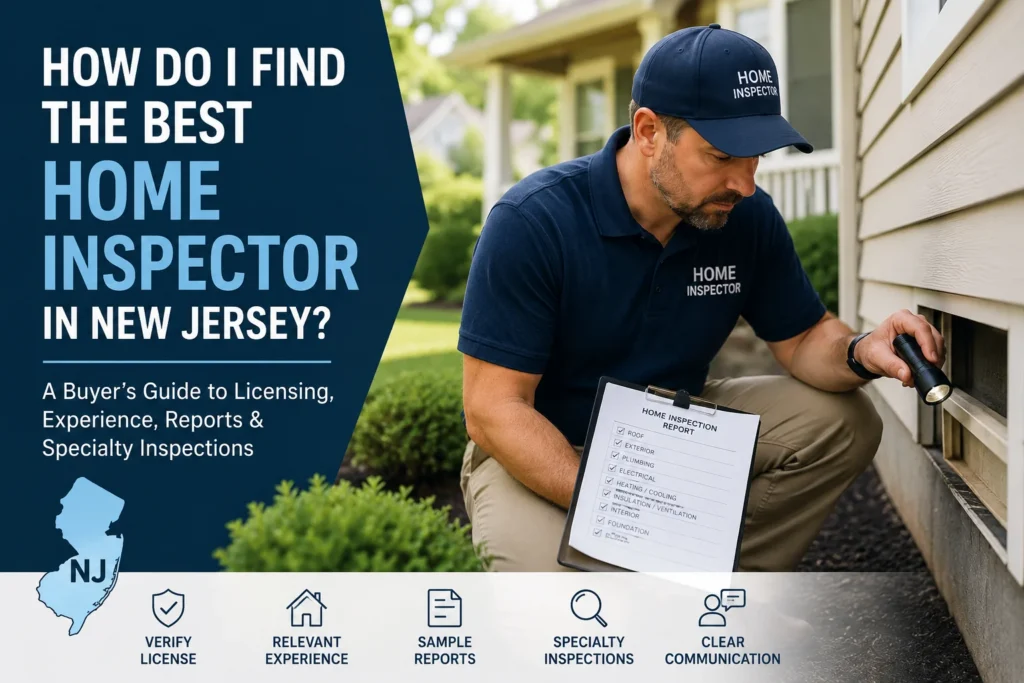
Choosing a home inspector is one of the most important decisions a New Jersey buyer makes after having an offer accepted. Buyers can review whether New Jersey Realtors provide home inspectors or buyers choose their own. A strong inspector can identify visible defects, explain which findings deserve further investigation, and help the buyer better understand the property before the inspection contingency expires.
The best home inspector is not necessarily the least expensive inspector, the person with the most online reviews, or whoever has the first available appointment. Buyers should look for an actively licensed New Jersey home inspector with relevant experience, a detailed reporting process, and the ability to clearly distinguish major concerns from routine home maintenance.
Quick Answer
- Verify the inspector’s active New Jersey license.
- Look for experience with similar homes and construction types.
- Review a sample inspection report before hiring.
- Confirm exactly what the quoted fee includes.
- Ask whether specialty inspections may be appropriate.
- Read recent reviews for thoroughness and communication.
- Avoid selecting an inspector solely by price or availability.
- Attend the inspection whenever possible.
Verify the Inspector’s New Jersey License
New Jersey regulates the home inspection profession through the Home Inspection Advisory Committee under the State Board of Professional Engineers and Land Surveyors. Before hiring anyone, buyers should verify the inspector through the New Jersey Division of Consumer Affairs.
Confirm that:
- The individual inspector’s license is active.
- The name matches the person who will actually inspect the property.
- The business information is consistent with the inspector’s website and agreement.
- The license has not expired.
- You understand whether the assigned inspector is the company owner or another employee.
Consider Professional Training and Association Membership
An active New Jersey license establishes that an inspector has met the state’s legal licensing requirements. Buyers may also consider whether the inspector participates in a professional organization that emphasizes continuing education, standards of practice, and ethical conduct.
The International Association of Certified Home Inspectors provides consumer guidance on how to choose the right home inspector. InterNACHI membership or certification can be a useful additional qualification, but it should not replace independent verification of the inspector’s New Jersey license, relevant experience, insurance coverage, and report quality.
Choose an Inspector Familiar With the Property Type
Experience should be relevant to the home being purchased. This is especially important because many New Jersey houses are older. An inspector who primarily examines newer condominiums may not be the best fit for a 1920s colonial with stone foundation walls, older electrical systems, a chimney, and possible underground oil tank history.
Older Homes
Ask about experience with older foundations, electrical systems, plumbing materials, chimneys, moisture intrusion, and prior heating conversions.
Condos and Townhouses
Confirm which interior components will be inspected and which exterior or shared systems may fall under the condominium association.
Rural Properties
Look for familiarity with private wells, septic systems, oil heat, crawlspaces, drainage, and detached structures.
Coastal or Flood-Prone Homes
Ask about crawlspace moisture, elevated mechanical systems, drainage, visible flood damage, corrosion, and ventilation concerns.
New Jersey housing conditions vary considerably. Inspectors working in Morris, Bergen, Essex, Union, or Hudson County may routinely encounter older housing stock, abandoned oil tanks, and aging sewer laterals. Inspectors in Sussex, Hunterdon, Warren, Monmouth, or Ocean County may encounter more septic systems, private wells, crawlspaces, or coastal moisture concerns.
Ask to See a Sample Inspection Report
A sample inspection report may tell you more than a company’s advertising. The report should be organized, readable, property-specific, and supported by photographs.
Look for a report that includes:
- Clear photographs of observed conditions
- The location of each important finding
- An explanation of why the condition matters
- Separation between material concerns and ordinary maintenance
- Recommendations for repair, monitoring, or specialist evaluation
- Identification of inaccessible areas or excluded systems
- A summary that supplements rather than replaces the full report
Understand What a Standard Home Inspection Covers
A New Jersey home inspection is generally a visual, functional, and non-invasive examination of readily accessible components. Inspectors ordinarily do not move furniture, personal property, soil, snow, stored items, or finished building materials to search for concealed defects.
A general inspection commonly evaluates accessible portions of the:
- Structure and foundation
- Exterior walls and siding
- Roof and drainage components
- Plumbing system
- Electrical system
- Heating and cooling systems
- Interior rooms and visible finishes
- Insulation and ventilation
- Fireplaces and solid-fuel-burning appliances
An inspection may not reveal a problem hidden behind drywall, beneath flooring, inside an underground pipe, under stored possessions, within an inaccessible crawlspace, or beneath recently installed cosmetic finishes.
Confirm What Is Included Before Comparing Prices
Two inspection quotes can represent substantially different services. Buyers should also review which add-on inspections may be appropriate for a New Jersey property. One inspector may quote only the general inspection, while another may include radon testing, a wood-destroying-insect inspection, infrared scanning, or additional structures.
| Service | Usually Included? | What to Confirm |
|---|---|---|
| General home inspection | Yes | Property size, detached structures, attic, crawlspace, and report delivery |
| Radon testing | Often separate | Certification, equipment, test duration, and laboratory procedure |
| Wood-destroying insects | Varies | Whether a separate report or certification is provided |
| Sewer camera inspection | Usually separate | Access point, full-line visibility, video, and written findings |
| Oil tank search | Usually separate | Equipment used, search area, and limitations |
| Septic inspection | Separate specialist | Tank access, flow evaluation, records, and scope |
| Private well testing | Usually separate | Laboratory, required parameters, timing, and physical well inspection |
| Chimney, pool, or mold evaluation | Usually separate | Specialist credentials and exact testing method |
Consider Additional New Jersey Inspections
The appropriate inspections depend on the property. Buyers should discuss the home’s age, location, utilities, heating history, and visible conditions with their attorney, inspector, and real estate professional.
Radon Testing
Radon is invisible, odorless, and tasteless, so it cannot be evaluated through a normal visual inspection. New Jersey maintains certification requirements for businesses and professionals conducting radon testing and mitigation.
Learn more through the New Jersey Department of Environmental Protection radon program.
Underground Oil Tank Search
Older New Jersey properties may have current or former oil heat. See what buyers should know about New Jersey houses with oil tanks. Even when the home now uses natural gas, an abandoned underground tank may remain on the property.
Review the state’s consumer guidance concerning oil tanks and insurance.
Sewer Camera Inspection
A general inspector ordinarily cannot see the interior of an underground sewer lateral. A camera inspection may reveal roots, cracks, offsets, deterioration, standing water, or obsolete piping materials.
Septic Inspection
A septic system requires a specialized evaluation. A standard home inspection does not replace a proper septic inspection or review of available health department records.
Private Well Testing
New Jersey requires water testing in many residential transfers involving private wells. Water-quality testing and examination of the physical well equipment are related but distinct services.
Chimney, Pool, and Mold Evaluations
A general inspector may identify visible warning signs, but a specialist may be needed to determine the full condition, extent of damage, or appropriate remediation.
Read Reviews for the Right Reasons
A high star rating can be useful, but the content of the reviews matters more than the average score.
Look for repeated comments describing the inspector as:
- Thorough and methodical
- Patient with buyer questions
- Experienced with older or unusual homes
- Clear about the significance of findings
- Prompt in delivering the written report
- Available for follow-up questions
- Able to distinguish major defects from ordinary maintenance
Be cautious when reviews focus almost entirely on speed, low price, or how quickly the inspection was completed. Also prioritize recent reviews because staffing, workload, and company procedures can change over time.
Ask How Long the Inspection Will Take
There is no universal inspection duration. The time required depends on the property’s size, age, condition, accessibility, and number of systems or additional services.
Ask the inspector:
- How much time is reserved for the property?
- Will one inspector or several inspectors attend?
- Are detached garages or accessory structures included?
- Will accessible attic and crawlspace areas be entered?
- When will the written report be delivered?
- Can the buyer call afterward with questions?
Buyers should be cautious when a company promises an unusually brief inspection of a large, older, or complicated property.
Attend the Home Inspection
Buyers should attend the inspection whenever scheduling permits. The inspection stage fits within the broader New Jersey home-buying process. The written report is essential, but walking through the property with the inspector provides context that photographs alone cannot always convey.
During the inspection, buyers may learn:
- Where the main water shutoff is located
- How to shut off the electrical service
- The approximate age of major systems
- Which findings require immediate attention
- Which findings are longer-term maintenance concerns
- How surface drainage moves around the property
- Which observations deserve specialist evaluation
Allow the inspector to work without constant interruption, but ask questions during appropriate points in the inspection or during the final walkthrough.
Do Not Hire an Inspector to “Pass” or “Fail” the House
A home inspector should provide an objective assessment rather than tell the buyer whether to complete or cancel the purchase. Nearly every home has defects.
Be cautious of inspectors who:
- Describe themselves primarily as deal makers or deal killers
- Promise they will find every possible defect
- Minimize serious concerns to keep a transaction moving
- Turn routine maintenance into unnecessarily alarming conclusions
- Provide repair estimates outside their expertise
- Pressure buyers to use a particular contractor
- Discourage appropriate specialty inspections
- Refuse to provide a sample report or written agreement
Questions to Ask Before Hiring a Home Inspector
- What is your New Jersey home inspector license number?
- Will you personally perform the inspection?
- How many inspections have you completed?
- Do you regularly inspect homes of this age and construction type?
- May I review a sample report?
- What is included in the quoted fee?
- Which areas or systems are excluded?
- Do you carry errors-and-omissions and general-liability insurance?
- Are you certified to perform radon testing in New Jersey?
- Do you offer or coordinate sewer, septic, oil tank, or well inspections?
- How long will the inspection likely take?
- When will I receive the report?
- Can I attend the entire inspection?
- Will you be available for follow-up questions?
Should I Use the Inspector Recommended by My Realtor?
A real estate agent may provide names of inspectors who have previously demonstrated reliability, availability, and strong communication. The buyer should still understand the distinction between a Realtor referral and the buyer’s inspector selection. That referral can be a useful starting point, particularly during a short inspection contingency.
The buyer should still make the final selection. Verify the inspector’s license independently, read recent reviews, examine a sample report, and confirm the scope of services before hiring.
Buyers are also free to hire an inspector recommended by an attorney, friend, family member, contractor, or prior client. The important question is not who provided the name, but whether the inspector is properly qualified for the property.
What Makes a Home Inspector the Best Choice?
The strongest candidates generally combine:
- Active New Jersey licensure
- Relevant experience with the property type
- A methodical inspection process
- Clear, property-specific written reporting
- Knowledge of when specialists are necessary
- Appropriate professional boundaries
- Good communication before and after the inspection
- Independence and objectivity
Price matters, but the inspection fee is relatively small compared with the possible cost of an undiscovered structural, environmental, sewer, septic, roofing, or mechanical problem. Buyers should also understand what may happen to the deposit if a buyer cancels after a home inspection.
- Do New Jersey Realtors Provide Home Inspectors?
- What Add-On Inspections Should I Consider?
- What Are the Steps in Buying a House in New Jersey?
- What Is Attorney Review in New Jersey Real Estate?
- Are New Jersey Houses With Oil Tanks Dangerous?
- How Can I Check if a House Is in a New Jersey Flood Zone?
- Why Are So Many New Jersey Houses Older?
- Can a Buyer Lose the Deposit After a Home Inspection?
- What Should First-Time Homebuyers Know in New Jersey?
- Are Buyer Commission Rebates Legal in New Jersey?
Buying a Home in New Jersey?
New Jersey buyers may also be able to reduce their closing expenses through a buyer commission rebate, subject to lender approval, attorney guidance, transaction terms, and other applicable requirements.
Learn About New Jersey Buyer RebatesFrequently Asked Questions
Are home inspectors required to be licensed in New Jersey?
Yes. New Jersey home inspectors are licensed and regulated through the Home Inspection Advisory Committee. Buyers should verify that the individual performing the inspection holds an active New Jersey license.
How much does a home inspection cost in New Jersey?
Pricing varies according to the home’s size, age, location, condition, construction, and the additional services ordered. Radon, sewer, oil tank, septic, well, chimney, pool, and mold evaluations may be separately priced.
Does a New Jersey home inspection include radon testing?
Not automatically. Radon testing is commonly offered as an additional service. Buyers should confirm that the person or company performing the test holds the appropriate New Jersey certification.
Does a home inspector check for underground oil tanks?
A general inspector may identify visible signs associated with current or former oil heat, but an underground oil tank sweep is generally a separate service. Buyers purchasing an older property or a home converted from oil to gas should ask whether a tank search is appropriate.
Should I attend my home inspection?
Yes, whenever possible. Attending allows the buyer to observe important conditions, learn about the home’s systems, and ask the inspector questions. The written report remains essential, but the on-site explanation provides useful context.
Final Takeaway
To find the best home inspector in New Jersey, begin with license verification and then evaluate the inspector’s relevant experience, reporting quality, inspection scope, professional training, and communication style.
Do not select an inspector solely because that person is the cheapest, has the earliest appointment, or was the first recommendation you received. Choose someone qualified to evaluate the particular type of home you are purchasing and willing to clearly explain both the findings and the limitations of the inspection.
A careful home inspection cannot eliminate every risk associated with buying a property, but it can provide substantially better information before the transaction proceeds toward closing.
This article is provided for general informational purposes and is not legal, engineering, environmental, insurance, or home inspection advice. Inspection scope, licensing requirements, testing procedures, and transaction rights may depend on the property and the terms of the purchase contract. Buyers should consult appropriately licensed professionals and their New Jersey real estate attorney.