
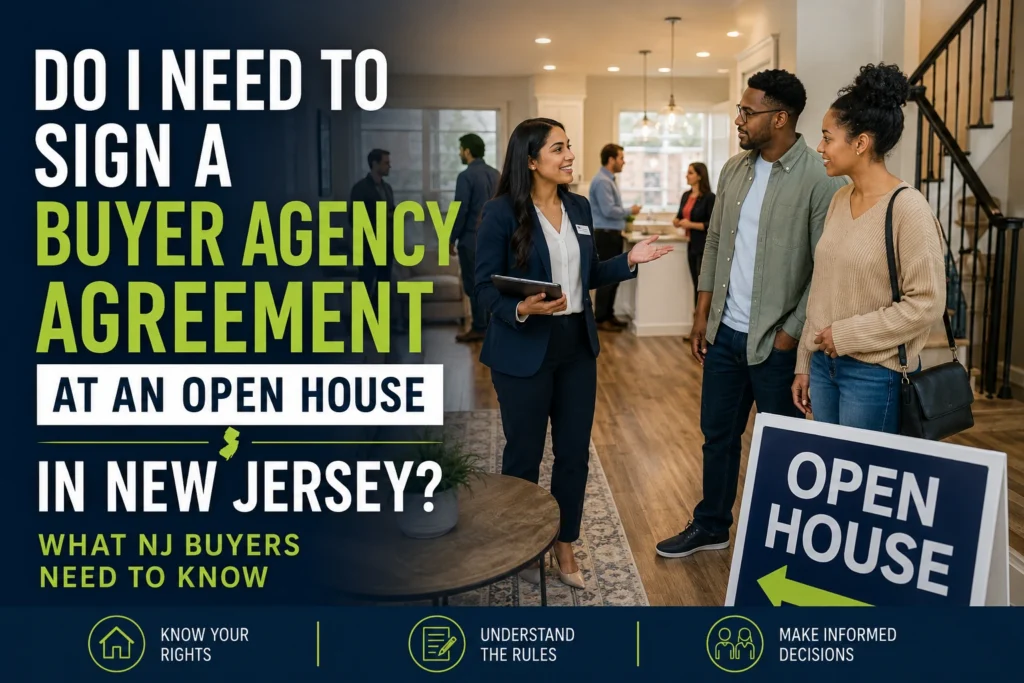
You see an open house sign, walk through the front door, and the agent asks you to register. Does entering the home mean you must also sign a buyer agency agreement?
For most New Jersey buyers, simply visiting an open house is not the same as hiring a buyer’s agent. You can ordinarily tour the property, review the listing information, and ask basic questions without agreeing that the agent will represent you.
Quick Answer
No, you generally do not need to sign a buyer agency agreement merely to attend an open house in New Jersey. A written agreement becomes relevant when a brokerage begins working with you as a buyer’s agent or transaction broker—not merely because you entered a publicly advertised open house.
Open House Visit
You may ordinarily tour the home and ask general property questions without retaining the hosting agent.
Private Representation
A written agreement may be required before an agent provides individualized buyer brokerage services.
Know the Difference
The agent hosting the open house usually represents the seller, not the visitors walking through it.
Why Are New Jersey Buyers Being Asked to Sign More Agreements?
Buyer agency agreements are not entirely new, but they became much more visible after major changes to real estate practices in 2024.
New Jersey’s Real Estate Consumer Protection Enhancement Act requires brokerage firms to use written brokerage services agreements in residential real estate transactions. These agreements clarify the brokerage relationship, the services being offered, the duration of the arrangement, and how the brokerage may be compensated.
The purpose is greater transparency. A buyer should know whether an agent represents the buyer, represents the seller, acts as a transaction broker, or is operating under another permitted relationship.
That does not mean every interaction with a real estate licensee immediately creates a formal buyer-agent relationship. An open house remains primarily a marketing event for the seller’s property.
Important distinction: An agent asking you to sign an open house registration sheet is not necessarily asking you to sign a buyer agency agreement. A sign-in sheet may simply document attendance, provide security information, or identify whether you are already represented.
What Is a Buyer Agency Agreement?
A buyer agency agreement is a contract between a buyer and a real estate brokerage. It establishes that the brokerage will represent the buyer in searching for, evaluating, negotiating for, or purchasing real estate.
Depending on the form and its terms, the agreement may address:
- Whether the relationship is exclusive or nonexclusive.
- The geographic area or types of property covered.
- The services the brokerage will provide.
- The beginning and expiration dates.
- How the buyer’s brokerage will be compensated.
- Whether another party may pay some or all of that compensation.
- The circumstances under which the agreement may be terminated.
- The buyer’s responsibilities while working with the brokerage.
A buyer agency agreement is therefore much more significant than an open house guest register. It should identify the actual business relationship between the buyer and brokerage.
Buyers who want a broader explanation of representation and compensation can also review What Is Buyer Agent Commission in New Jersey?
Can I Walk Through a New Jersey Open House Without Signing One?
Generally, yes. A typical open house is advertised to the public so prospective buyers can view the property during a specified window of time.
As an open house visitor, you can ordinarily:
- Enter and walk through the home.
- Review the listing sheet and seller-provided materials.
- Ask about the asking price, property features, taxes, or included items.
- Ask whether offers have been received.
- Determine whether you want to pursue the property further.
- Leave without hiring the hosting agent.
Touring the property does not, by itself, mean the hosting agent has agreed to advise you, negotiate for you, or protect your confidential interests.
An Open House Is Not a Private Buyer Consultation
The hosting agent is there to market the seller’s property. Answering basic questions about the home does not necessarily turn that agent into your representative.
Who Does the Agent at the Open House Represent?
In most cases, the agent hosting the open house is the listing agent, another licensee from the listing brokerage, or an agent conducting the event on behalf of the seller.
That agent generally represents the seller unless a different brokerage relationship has been properly established and disclosed.
New Jersey requires open house disclosures intended to make the agent’s role clearer. The disclosure is important because an unrepresented visitor may otherwise assume that the friendly agent answering questions is also advising the buyer.
Those are not the same thing.
A seller’s agent may explain factual information about the property and the transaction, but the agent’s primary duties remain with the seller. The seller’s agent is attempting to generate interest, identify potential buyers, and obtain the most favorable transaction available for the homeowner.
Be Careful About Revealing Negotiating Information
Because the hosting agent may represent the seller, buyers should be cautious about volunteering information that could weaken their negotiating position.
For example, avoid casually announcing:
- “This is the only house we have liked.”
- “We need to move within 30 days.”
- “We can afford much more than the asking price.”
- “We would probably waive the inspection.”
- “Our current lease expires next month.”
- “We will do whatever it takes to win.”
That information may be useful to the seller when evaluating your eventual offer. You can be courteous and ask reasonable questions without disclosing your maximum price or urgency.
Open House Versus Private Showing
The practical distinction becomes clearer when comparing a public open house with a private showing arranged specifically for you.
| Issue | Public Open House | Private Buyer Showing |
|---|---|---|
| Who arranged it? | The seller or listing brokerage schedules a public viewing period. | An agent schedules an individual appointment for a particular buyer. |
| Who is the agent serving? | The host generally serves the seller and markets the listing. | The agent may be providing individualized services to the buyer. |
| Is a buyer agreement typically needed? | Not merely to enter and tour the property. | It may be required before the agent begins providing buyer brokerage services. |
| Does the buyer receive strategic advice? | Not from the seller’s representative on a confidential fiduciary basis. | A buyer’s agent may advise the buyer on pricing, terms, risks, and negotiation. |
| Can the buyer leave without further obligation? | Ordinarily, yes, unless the buyer separately signed another agreement. | The buyer’s obligations depend upon the written agreement’s terms. |
When Might an Agreement Become Necessary?
The issue changes when you move beyond casually viewing the open house and ask an agent to begin working for you.
A written brokerage services agreement may become appropriate before the agent provides services such as those involved in scheduling private showings in New Jersey:
- Identifying properties based on your individual criteria.
- Scheduling private showings for you.
- Researching comparable sales.
- Advising you about an offer price.
- Recommending contract terms or contingencies.
- Preparing and submitting an offer.
- Negotiating with the seller or listing brokerage.
- Coordinating inspections, appraisal, and transaction deadlines.
These are personalized brokerage services. At that stage, the agent is no longer merely hosting a seller’s open house.
The precise timing may depend on the services requested and the relationship being established. The key question is not simply, “Did I meet this agent at an open house?” It is, “Has this brokerage started working with me in a defined buyer brokerage relationship?”
What If I Want to Make an Offer on the Open House?
You are not required to hire the listing agent merely because you discovered the home at that agent’s open house.
You generally have several possible paths. Buyers considering proceeding without representation should also review whether to buy a New Jersey house without a Realtor.
You generally have several possible paths:
- Use your existing buyer’s agent. Your agent can prepare the offer and communicate with the listing brokerage.
- Hire a different buyer’s agent. You may select another brokerage to represent you before proceeding.
- Ask the listing brokerage about its available relationships. This may involve disclosed dual agency, designated agency, or another permitted arrangement, depending on the brokerage and circumstances.
- Proceed without buyer representation. An unrepresented buyer may submit an offer through the listing side, although the listing agent remains responsible for the seller’s interests.
Each approach has different consequences. Buyers should understand who will advocate for them, who will remain neutral, and who will continue representing the seller.
For a broader overview of agency conflicts, see What Is Dual Agency in New Jersey Real Estate Transactions?
You Do Not “Belong” to the Open House Agent
Walking into an open house, speaking with the host, or taking a brochure does not automatically make that agent your buyer’s agent. Representation should be knowingly established—not assumed from a brief encounter.
What If the Agent Says You Must Sign Before Entering?
A brokerage may establish its own procedures for interacting with potential clients, but buyers should distinguish between a basic visitor registration form and a substantive representation contract.
Before signing, ask the agent to identify the document clearly.
You might say:
“Is this only an open house registration form, or is it a brokerage services or buyer representation agreement?”
If it is a buyer agency agreement, you should not be pressured to sign it without understanding the terms. Ask why the agreement is being requested, what services are being offered, and whether you would be committing to use that brokerage for other properties.
If you do not want to establish a representation relationship at that time, say so plainly.
Exclusive Versus Nonexclusive Buyer Agreements
Not every buyer agreement has the same scope.
Exclusive Buyer Agency Agreement
An exclusive agreement may obligate you to work through one brokerage during the agreement period. Depending on the contract, the brokerage may be entitled to compensation if you purchase a covered property during that period—even if you first encountered the property through another source.
Nonexclusive Agreement
A nonexclusive agreement may permit you to work with more than one brokerage, subject to its specific terms. Compensation may depend on which brokerage performed the services that led to the transaction.
Property-Specific or Limited Agreement
Some agreements may be limited to one property, one showing, a specified geographic area, or a short period. A limited arrangement can be useful when a buyer is not prepared to make a broader commitment.
Never rely solely on the document’s title. Read the duration, exclusivity, compensation, and termination sections.
Questions to Ask Before Signing a Buyer Agency Agreement
Buyer Agreement Checklist
- Is this agreement exclusive or nonexclusive?
- Does it cover one property or my entire home search?
- When does the agreement begin and expire?
- Can I cancel it, and how must cancellation be delivered?
- What specific services will the brokerage provide?
- How much compensation is the brokerage seeking?
- Could I owe money if the seller pays less than that amount?
- Does the agreement cover homes I find on my own?
- What happens if the same brokerage represents the seller?
- Will I be shown properties offering different compensation amounts?
Broker commissions are negotiable. A buyer should understand the compensation obligation before signing rather than assuming that the seller will always pay the full amount.
Can the Seller Still Pay the Buyer’s Brokerage?
Yes. The existence of a buyer agency agreement does not prevent a seller from agreeing to pay buyer-broker compensation as part of the transaction.
However, compensation is no longer something buyers should treat as automatic or uniform. The amount may be negotiated through the offer and contract process.
A buyer agency agreement should explain the compensation being sought and what may happen if the amount paid by the seller or listing brokerage is less than the buyer’s contractual obligation.
Buyers should also understand that commission arrangements can affect their closing costs and negotiating strategy. The broader transaction is explained in the New Jersey real estate offer-process guide. Read Are Buyer Commission Rebates Legal in New Jersey? for an explanation of how some brokerages return a portion of earned compensation to qualified buyers at closing.
Can I Bring My Own Agent to an Open House?
Yes. You can attend an open house with your buyer’s agent, although many buyers visit independently because the property is already open to the public.
If you attend without your agent, tell the hosting agent that you are already represented. Enter your agent’s name on the sign-in sheet when requested and avoid asking the listing agent for individualized representation or negotiation advice.
You can then contact your own agent after the open house to discuss:
- Comparable sales and probable market value.
- The home’s time on the market.
- Potential offer terms.
- Inspection and appraisal considerations.
- Seller disclosures.
- Buyer-broker compensation.
- Whether the property fits your broader search.
What Should First-Time Buyers Know?
First-time buyers are particularly vulnerable to confusing agency relationships because they may assume every real estate agent they meet is there to help them equally.
At an open house, separate the agent’s helpful manner from the agent’s legal role. A professional listing agent can answer questions and treat buyers fairly while still representing the seller.
You should know the answers to three questions before discussing your finances or negotiating strategy:
- Who does this agent currently represent?
- Has the agent agreed to represent me?
- Have I signed a document creating any obligation?
Buyers who are just beginning their search may also benefit from What Are the Steps in Buying a House in New Jersey? and What Should First-Time Homebuyers Know in New Jersey?
Common Misconceptions About Open Houses and Buyer Agreements
| Common Belief | What Buyers Should Understand |
|---|---|
| “I signed in, so that agent now represents me.” | A visitor log is not automatically a buyer agency agreement. |
| “The open house agent answered my questions, so the agent is working for me.” | The agent may simply be performing the listing brokerage’s duty to market the property. |
| “I must use the agent who showed me the home.” | Attending a public open house does not ordinarily require you to hire the host. |
| “A buyer agreement means I must pay the entire commission in cash.” | The seller may agree to pay some or all buyer-broker compensation, but the terms must be understood and negotiated. |
| “All buyer agency agreements are identical.” | Duration, exclusivity, services, compensation, and cancellation terms can differ. |
The Bottom Line
You generally do not need to sign a buyer agency agreement simply to attend an open house in New Jersey. A public open house allows buyers to inspect a property and obtain general information without automatically retaining the hosting agent.
A written agreement becomes more relevant when a brokerage begins providing individualized services to you as a buyer, such as arranging private appointments, advising you on price, preparing an offer, or negotiating on your behalf.
The most important step is to identify the document before signing it. Determine whether it is merely an attendance record or an actual brokerage contract. Then review the agreement’s scope, duration, exclusivity, compensation, and termination terms.
Open houses should help you evaluate properties—not pressure you into an agency relationship you do not understand.
Continue Your New Jersey Home-Buying Research
- What Are the Steps in Buying a House in New Jersey?
- Do I Need an Appointment to View Houses in New Jersey?
- What Is Buyer-Agent Commission in New Jersey?
- Are Buyer Commission Rebates Legal in New Jersey?
- What Is Dual Agency in New Jersey?
- Can I Buy a House Without a Realtor in New Jersey?
- How Does the New Jersey Real Estate Offer Process Work?
- What Should First-Time Homebuyers Know in New Jersey?
- What Is Attorney Review in New Jersey Real Estate?
- New Jersey Department of Banking and Insurance Bulletin 24-11
Frequently Asked Questions
Do I have to sign a buyer agency agreement just to enter an open house?
Generally, no. Merely attending a publicly advertised open house and viewing the property does not ordinarily require you to hire the hosting agent as your buyer’s agent.
Is an open house sign-in sheet a buyer agency agreement?
Not necessarily. A sign-in sheet may only record attendance and determine whether visitors are already represented. Read the document carefully and ask whether it creates a brokerage relationship before signing.
Who does the agent hosting an open house represent?
The hosting agent usually represents the seller or is conducting the open house on behalf of the listing brokerage. The agent does not automatically represent each buyer who enters the property.
When would I need a buyer agency agreement in New Jersey?
A written brokerage services agreement generally becomes relevant when a brokerage begins working with you in a buyer agency or transaction brokerage relationship and provides individualized brokerage services.
Can I make an offer without using the open house agent?
Yes. You may use your existing buyer’s agent, retain another brokerage, discuss available agency relationships with the listing brokerage, or proceed as an unrepresented buyer. Each choice has different consequences.