
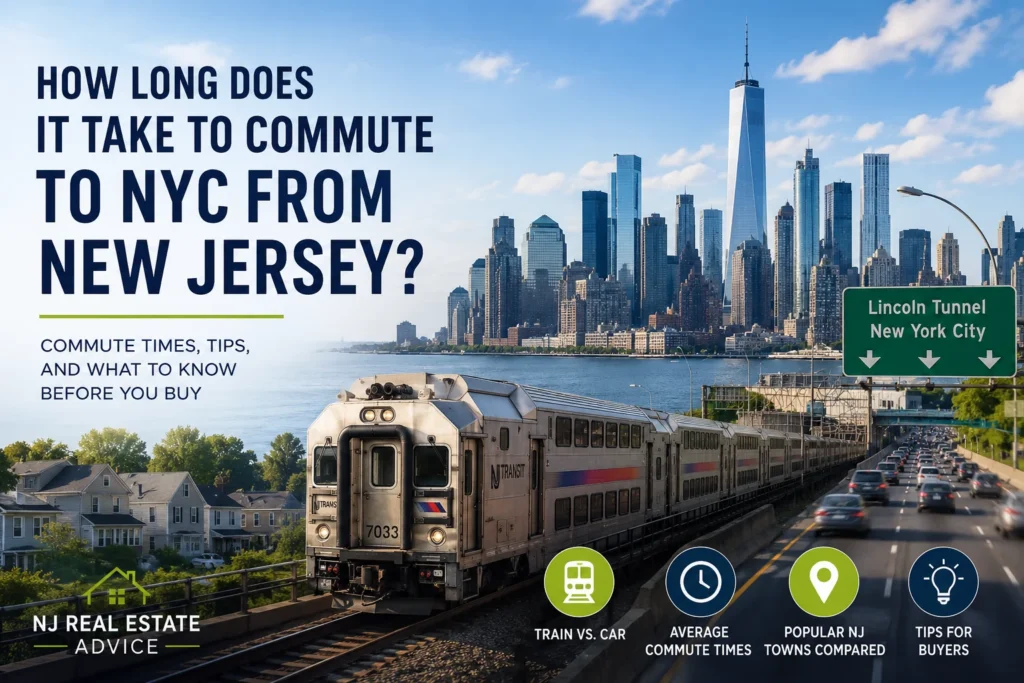
Commuting from New Jersey to New York City can take anywhere from approximately 20 minutes to more than 90 minutes each way. The realistic time depends on where you live, where you work in New York, whether you use a train, PATH, bus, ferry or car, and how long it takes to reach the station and complete the final portion of the trip.
New Jersey offers many practical alternatives to living inside New York City, but a location that looks close to Manhattan on a map does not necessarily produce a short daily commute. A buyer must evaluate the entire door-to-door trip—not merely the scheduled train ride.
For example, a train may reach New York Penn Station in 40 minutes, but the commuter may also spend 10 minutes driving to the station, 10 minutes parking and walking to the platform, and another 20 minutes traveling from Penn Station to an office on the East Side or in Lower Manhattan. That nominal 40-minute train ride can therefore become a 75- or 85-minute commute.
Typical Commute Times From New Jersey to New York City
The following ranges are general planning estimates. They are not live schedules and should not be used as a promise that a particular trip will take a certain number of minutes. Individual neighborhoods within the same municipality may have very different access to a station, highway, bus stop or ferry terminal.
| New Jersey Area | Common Transportation | Approximate Terminal-to-Terminal Time | Possible Door-to-Door Range |
|---|---|---|---|
| Jersey City | PATH, ferry or bus | About 10–25 minutes | Approximately 25–55 minutes |
| Hoboken | PATH, ferry, bus or NJ Transit connection | About 10–30 minutes | Approximately 25–60 minutes |
| Weehawken | Ferry or bus through the Lincoln Tunnel | About 15–35 minutes | Approximately 30–65 minutes |
| Secaucus | NJ Transit train or bus | About 10–30 minutes | Approximately 30–65 minutes |
| Newark | NJ Transit, PATH or bus | About 20–40 minutes | Approximately 35–70 minutes |
| Montclair | NJ Transit train or bus | About 35–60 minutes | Approximately 50–85 minutes |
| Summit | NJ Transit train | About 40–60 minutes | Approximately 55–85 minutes |
| Westfield | NJ Transit train or bus | About 45–65 minutes | Approximately 60–95 minutes |
| Morristown | NJ Transit train or commuter bus | About 60–80 minutes | Approximately 75–110 minutes |
| Parsippany | Commuter bus, driving or drive-to-train | About 50–90 minutes | Approximately 70–120 minutes |
| Woodbridge | NJ Transit train | About 40–60 minutes | Approximately 55–90 minutes |
| Edison | NJ Transit Northeast Corridor train | About 50–70 minutes | Approximately 65–100 minutes |
| Princeton Area | Drive or shuttle to Princeton Junction, then train | About 60–85 minutes | Approximately 80–120 minutes |
Calculate the Complete Door-to-Door Commute
The most common mistake is comparing houses only by the published time between a New Jersey station and a New York terminal. That number may represent less than two-thirds of the actual daily journey.
A realistic estimate should include every segment. It should also include a modest buffer because missing one train or bus can add considerably more than the scheduled headway suggests.
Example: A “45-Minute Train” May Become an 80-Minute Commute
Total estimated time: 80 minutes each way, before adding a delay or missed-connection buffer.
Is It Faster to Take a Train or Drive From New Jersey to NYC?
Neither option is universally faster. The better choice depends on the home’s location, workplace location, schedule, parking availability and tolerance for uncertainty.
Commuting by Train or PATH
- Travel time is often more predictable than peak-hour driving.
- Riders can read, work or rest instead of operating a vehicle.
- Direct service may eliminate the cost of Manhattan parking.
- Station parking permits may be limited or municipality-specific.
- A transfer can make the trip substantially longer.
- Delays and service changes still require contingency planning.
Commuting by Car
- Driving offers flexibility for irregular hours and multiple stops.
- Tunnel, bridge and Manhattan traffic can change quickly.
- Tolls, fuel and parking can materially increase commuting costs.
- A crash or road closure may add significant travel time.
- Driving may work better for jobs outside Manhattan’s central business districts.
- Hybrid workers may tolerate driving costs more easily than daily commuters.
Commuter Buses
Commuter buses can be practical from towns that do not have direct rail service. Some routes provide one-seat service to the Port Authority Bus Terminal, while others require a park-and-ride or local transfer. The scheduled ride may be convenient, but Lincoln Tunnel congestion can make travel times more variable.
Ferries
Ferries can provide a comfortable and relatively direct trip from parts of Hudson and Bergen counties. They may be especially attractive for commuters working near Manhattan’s west side or Lower Manhattan. However, the price, terminal access and connecting shuttle or subway ride must be included in the comparison.
Your New York City Destination May Matter More Than the New Jersey Town
“Commute to New York City” is too broad to produce one useful answer. A home may work well for an employee near New York Penn Station but poorly for someone reporting to an office near Grand Central, Wall Street, the Upper East Side or Brooklyn.
| Primary NJ Arrival Point | Often Convenient For | Possible Additional Travel |
|---|---|---|
| New York Penn Station | Midtown West, Herald Square, Madison Square Garden and nearby offices | Subway, crosstown bus or walk for East Side and downtown destinations |
| Port Authority Bus Terminal | Times Square, Midtown West and many subway connections | Walk or subway for offices farther east, north or downtown |
| PATH World Trade Center | Financial District and Lower Manhattan | Subway or walking connection for Midtown and uptown destinations |
| PATH 33rd Street | Herald Square, Koreatown, Midtown South and nearby subway lines | Additional subway or walk for farther destinations |
| Manhattan Ferry Terminals | West Side and selected Lower Manhattan destinations | Shuttle, bus, subway or walk after leaving the ferry |
How Much Time Does Rush Hour Add?
Rush hour affects every commuting method, although it affects them differently. Drivers and bus riders may encounter tunnel or bridge backups. Train riders may experience crowding, boarding delays or reduced flexibility when a scheduled connection is missed.
A commute should therefore be tested at the actual time the buyer expects to travel. A route tested at 11:00 a.m. on a Tuesday does not necessarily reveal what will happen at 7:30 a.m. on a weekday or during a severe weather event.
Factors That Can Extend a New Jersey-to-NYC Commute
- Limited or remote station parking.
- A wait for a connecting train, bus, PATH train or subway.
- Traffic approaching the Lincoln Tunnel, Holland Tunnel, George Washington Bridge or other crossings.
- Weather-related service changes.
- Track maintenance or construction.
- Walking time inside a large terminal.
- Crowded subway platforms or missed trains.
- A workplace that is far from the New York arrival terminal.
Should You Pay More to Live Near a Train Station?
Proximity to a useful station can have significant practical value, but buyers should not automatically assume that the closest house is the best purchase. The decision involves a combination of commute quality, home price, property taxes, parking, noise, housing condition, lot size and lifestyle.
A buyer may willingly accept a smaller house or higher purchase price in exchange for walking access to a direct train. Another buyer who works remotely three days per week may prefer a larger property farther from the station. The correct choice depends on how frequently the commute will actually occur and how burdensome each additional segment feels.
Does a Direct Train Always Produce the Best Commute?
Direct service is valuable because it removes the risk and inconvenience of a transfer, but it is not the only consideration. A direct train that runs infrequently may be less useful than a route with a simple transfer and more departure options.
Buyers should examine the full weekday schedule rather than focusing on one favorable express train. Consider what happens when you leave work early, stay late, miss the preferred departure or need weekend service.
How Hybrid Work Changes the Housing Decision
Hybrid work has made longer New Jersey commutes tolerable for some buyers. A 75-minute trip may feel unreasonable five days per week but manageable twice per week, particularly when it allows the buyer to obtain more space, a yard or a preferred community.
However, employment arrangements can change. Buyers should consider whether they could still tolerate the commute if office attendance increased. Purchasing a house based entirely on a temporary remote-work policy can create a future mismatch between location and employment.
Questions New Jersey Homebuyers Should Ask Before Choosing a Commuter Town
Test the Commute Before Buying the House
Online maps and transit schedules are useful screening tools, but they do not replace an actual test. Before committing to a location, make the trip under conditions that resemble your expected workday.
- Leave from the neighborhood at the time you would normally depart.
- Use the same station, parking facility or bus stop you expect to use.
- Take the route all the way to the workplace—not only to the Manhattan terminal.
- Repeat the return trip during the evening rush.
- Test a backup option in case the preferred route is unavailable.
- Calculate the annual cost of tickets, parking, tolls, fuel and subway fares.
This test may change how you compare two homes. A house that is geographically farther from Manhattan may have a simpler one-seat ride, while a closer house may require several unreliable connections.
Buying in New Jersey While Commuting to New York City?
ListOneNJ helps qualifying New Jersey buyers evaluate homes, prepare and negotiate offers, and navigate the purchase through closing. Its buyer commission rebate program returns 50% of the buyer-agent compensation actually received by ListOneNJ, subject to the written buyer agreement, lender approval, attorney guidance and settlement requirements.
Explore the ListOneNJ Buyer Rebate Program